The Many Ways Nature Shows Us How to Care
If you take a moment to look around in nature, you’ll find that mothering shows up in all kinds of ways and not always in the same form.
Consider the emperor penguin. In the harsh cold of Antarctica, the mother lays her egg and carefully transfers it to the father, who balances it on his feet
to keep it warm while she travels miles to find food. When she returns, they switch roles. It’s a quiet example of partnership, doing whatever needs to be done even when it’s difficult.
Then there’s the mother bear. Strong and protective, she teaches her cubs how to survive...where to find food, how to stay safe, and when
to stand their ground. Yet with her cubs, she’s gentle and patient. Strength and tenderness, side by side.
Elephants offer something different. Their young are raised within a herd, guided not just by their mothers but by a wise matriarch and other females. The calves are surrounded, protected, and gently taught as they
grow. It’s a reminder that care can come from a circle, not just one set of hands.
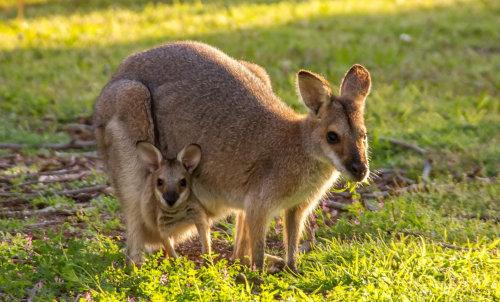
Kangaroo mothers carry their tiny, underdeveloped joeys safely tucked inside their pouch, keeping them close for months as they grow stronger. Safe, warm, and always within reach. It’s protection in its most constant
form.
Out in the fields and trees, songbirds make hundreds of trips each day, back and forth to the nest, feeding their young. No recognition. No pause. Just steady, consistent care. It’s the kind of love that shows up in small ways, over and over again.
In the ocean, the octopus mother may spend months guarding her eggs, gently tending to them without leaving, giving everything she has to ensure they survive. It’s one of nature’s most striking examples of selfless devotion.
Even alligators, often seen as fierce and distant, show surprising care. A mother will gently carry her hatchlings in her mouth to the water, protecting them during their most vulnerable moments.
Different animals. Different environments. Different approaches. Yet the message is the same. Care
can be strong or gentle. Shared or solitary. Loud or quiet. It can look like protection, patience, consistency, or sacrifice.
Just like in nature, it’s these instincts...quiet, steady, and deeply rooted...that help life grow, thrive, and carry on.
Enjoying my newsletter? Please REPLY and let me know! Also, please forward this newsletter to 5 of your family members and/or
friends and share the love!
Here's what just one GON reader had to say...
"Good afternoon Maria,
I slept late this morning, that happens sometimes after a busy day. As I age, though only 78, I think more about making life easier to manage. I thought about it especially this morning as my 92 year old friend and I were
visiting.
When I was able to get to your newsletter, you were speaking about margins (January 20th issue) and how they
support our lives. That’s so true.
But there’s something else that’s also true. Reading well-written text supports our lives because it allows us to understand readily, as opposed to struggling to decipher what the author was trying
to say. While I often think about how well you write, this is the first time I’ve thought of your writing, in addition to your content, as a means of supporting your readers. This is just one more nugget of value that you generously share with us and we gratefully receive.
In Louisiana, we call that
Lagniappe (lan-yap), a little something extra. The older I get, the more I appreciate understanding as decoding can be difficult and time consuming. Thank you for all you do, your content, your products and your writing skills."
-- Louise in Louisiana