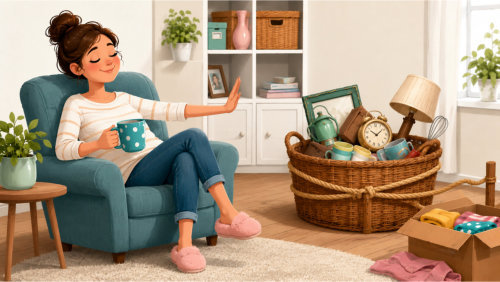
Most of us have an inner voice that speaks up whenever we're about to let something
go.
"I might need this someday."
"It was expensive."
"Someone could use it."
"What if I regret getting rid of it?"
For some people, those thoughts only pop up
occasionally. Others find themselves hanging onto just one category of items...craft supplies, books, kitchen gadgets, clothing, holiday decorations, or sentimental keepsakes. And for a small number of people, those thoughts become so overwhelming that they contribute to true hoarding disorder. But for many of us, it's simply our "inner hoarder" talking.
The good news? That voice doesn't have to make every decision.
Recognize the Voice
The first step is learning to recognize when your inner hoarder has taken over. It often disguises itself as logic. Instead of
asking, "Do I use this?" it asks, "What if I need it someday?" Instead of focusing on your life today, it focuses on imaginary situations that may never happen.
There's nothing wrong with preparing for the future, but if you're saving dozens of items for unlikely scenarios, your home ends up storing possibilities instead of supporting
your everyday life.
Put It in Time-Out
Imagine treating your inner hoarder like an overly enthusiastic child. When it starts shouting, "Keep everything!" don't argue with it. Simply say, "Thanks for your opinion, but you're taking a little
break while I make this decision." It may sound silly, but mentally separating yourself from those anxious thoughts can make decluttering much easier. You're still making the decision...not fear.
Ask Better Questions
Instead of asking
whether you could use something someday, ask questions that focus on the present.
Have I used this in the past year? Would I buy this again today? If I needed one later, could I replace it?
Does this item earn the space it takes up? Is someone else more likely to benefit from it than I am? These questions shift your thinking from
scarcity to practicality.
Beware of "Just in Case"
"Just in case" is one of the biggest reasons clutter accumulates. One flashlight? Sensible. Eight flashlights? Probably unnecessary. One extra extension cord? Helpful. A tangled box of
twenty-five cords that fit electronics you no longer own? That's your inner hoarder negotiating. It's okay to prepare for real-life situations. The trick is recognizing when "prepared" quietly becomes "overprepared."
Remember That Space Has Value
Many people think only about the value of the object.
But your shelves have value, too. Your closets have value. Your cabinets have value. Every item you keep pays rent by taking up space in your home. If something hasn't served a purpose in years, it may no longer be worth the space it's occupying.
Sometimes
the best use of that space is simply having room to breathe.
Start with the Easy Wins
You don't have to tackle sentimental treasures first.
Instead, give your
inner hoarder a few practice rounds. Recycle old magazines. Donate clothes that no longer fit. Throw away dried-up pens. Recycle outdated instruction manuals.
As you build confidence, your decision-making muscles become stronger. You'll realize that letting go isn't nearly as difficult as your inner hoarder
predicted.
Celebrate Progress, Not Perfection
No one becomes a minimalist overnight, and that's not the goal. The goal is creating a home that supports your current life...not preserving every possibility from the past. If you let go of
five things today that you would have kept a year ago, that's progress. If you donate one box that's been sitting in the basement for months, that's progress. Every thoughtful decision weakens the voice that says, "Keep it."
The Bottom Line
Your inner hoarder isn't trying to make your life harder. It's simply trying to protect you from making a mistake. But sometimes that protective instinct hangs onto far more than you truly need.
The next time you hear that familiar voice insisting you keep something "just in case," smile, thank it for its
concern, and give it a brief time-out.
You may discover that making decisions becomes easier, your home feels lighter, and the things you choose to keep become even more meaningful.
P.S. On another note...Practical Essentials for Every HomeYou're sure to love my collection of reliable, everyday items that help keep your home comfortable, organized, and running smoothly. From
bedding and towels to kitchen tools and household basics, these are practical products you'll reach for again and again. Visit:Practical Essentials for Every Home